

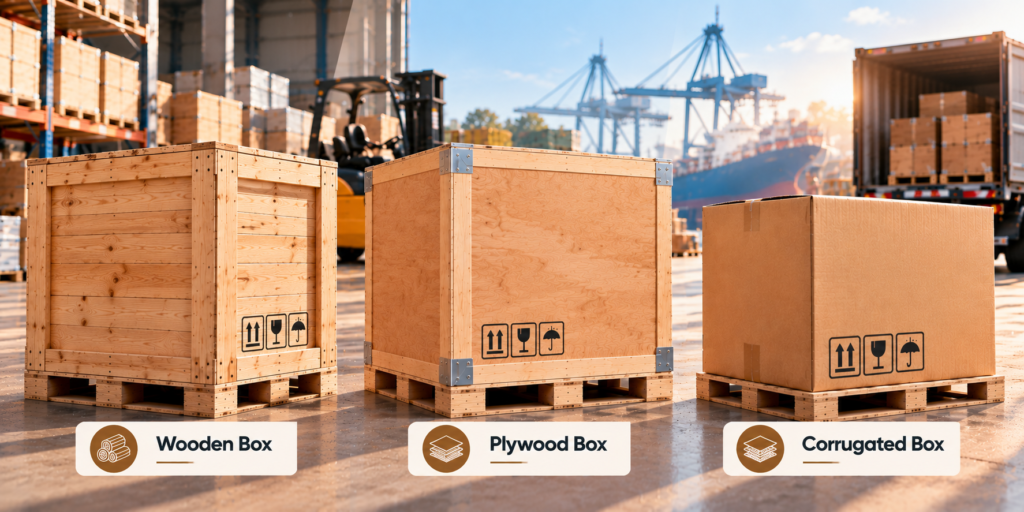
Wooden Box vs Plywood Box vs Corrugated Box: Which Is Best for Industrial Shipping?
A packaging box may look strong enough in the warehouse, but the real test begins when the shipment leaves the factory. Loading, unloading, stacking, road vibrations, and changing weather conditions can all affect how well a package protects its contents.
For manufacturers, choosing between a wooden box, plywood box and corrugated box is an important part of shipment planning. Each material behaves differently under weight, pressure, and handling conditions.
The right choice depends on what you are shipping, how it will be transported, and the protection it requires. This guide compares the three commonly used industrial packaging boxes to help you make a suitable decision.
What Determines the Right Industrial Packaging Box?
Before comparing materials, consider the conditions your package will face.
A small electrical component and a large machine assembly cannot be packed using the same approach, even if their shipping routes are identical.
Start by evaluating:
- Product weight: The packaging must support the load without losing structural stability.
- Dimensions: Large or irregular products may need customized supports.
- Handling: Forklift movement, lifting, and repeated loading can create additional stress.
- Transportation: Road, sea, and air shipments have different handling and environmental conditions.
- Product sensitivity: Fragile or moisture-sensitive equipment needs additional protection.
- Stacking requirements: Boxes must withstand the pressure of goods placed above them.
Understanding these requirements helps manufacturers avoid both inadequate packaging and unnecessary material expenses.
Wooden Boxes: Built for Demanding Industrial Shipments
Wooden boxes are commonly selected when shipping equipment that requires a rigid, reinforced outer structure.
Manufactured using solid timber, these boxes can be designed with supporting frames, skids, and internal bracing to accommodate heavy or unevenly distributed loads.
Where Are Wooden Boxes Used?
Wooden packaging is commonly considered for:
- Heavy machinery and industrial motors
- Automotive castings and forgings
- Large mechanical assemblies
- Industrial tools and oversized spare parts
- Equipment requiring reinforced export packaging
Advantages of Wooden Boxes
Structural support: Properly designed timber packaging can handle substantial weight and demanding lifting operations.
Flexible construction: Box dimensions, reinforcements, and internal supports can be adapted to different equipment.
Repair and reuse: Many wooden boxes can be repaired and used again when their condition permits.
Limitations
Wooden packaging can increase shipment weight, affecting freight and handling expenses. Timber quality and moisture exposure also require attention.
For international shipping, regulated solid-wood packaging generally needs to satisfy ISPM 15 requirements.
Best choice: Heavy equipment and oversized components and products requiring substantial structural reinforcement.
Plywood Boxes: A Practical Balance of Strength and Weight
Plywood boxes provide another option for manufacturers looking for protective packaging without unnecessary weight.
They are made using engineered wood panels consisting of bonded veneer layers. Depending on the construction, plywood packaging may use additional frames, supports, or collapsible components.
Unlike conventional timber boxes, plywood designs can provide relatively smooth enclosed surfaces and efficient use of storage space.
Where Are Plywood Boxes Used?
Typical applications include:
- Electrical control panels
- Precision measuring instruments
- Automotive components
- Electronic assemblies
- Medium-sized industrial equipment
Advantages of Plywood Boxes
Controlled packaging weight: Plywood construction can provide the required support with less material weight than some solid-timber alternatives.
Custom designs: Panel thickness, internal arrangements, and reinforcements can be selected according to product requirements.
Storage efficiency: Certain collapsible designs occupy less space when not in use.
Product protection: Enclosed panels can help protect equipment from external contact during handling.
Limitations
Plywood edges may absorb moisture without suitable sealing. Heavier equipment can also require additional reinforcement, increasing material and construction costs.
Best choice: Electrical equipment, precision components, and shipments where both structural support and packaging weight matter.
Corrugated Boxes: Efficient Packaging for Suitable Industrial Products
Corrugated boxes are often associated with consumer goods, but they also have an important role in industrial shipping.
These boxes use fluted paperboard between liner sheets. Different board grades and single-wall, double-wall, or triple-wall constructions allow packaging designers to accommodate a range of product requirements.
Where Are Corrugated Boxes Used?
- Automotive replacement parts
- Small electrical components
- Industrial accessories
- Lightweight engineering products
- Multiple small items packed together
Advantages of Corrugated Boxes
Lower shipping weight: Paperboard packaging adds relatively little weight to a shipment.
Custom sizing: Boxes can be manufactured to suit product dimensions, with partitions or inserts added where necessary.
Storage convenience: Flat-packed boxes take up less warehouse space before assembly.
Material efficiency: Corrugated packaging can be an economical choice for suitable shipping applications and is widely recyclable.
Limitations
Humidity can weaken corrugated board and reduce its stacking performance. Heavy concentrated loads and repeated rough handling may also require reinforced packaging designs.
Best choice: Lightweight and medium-weight products where shipping efficiency, customization, and cost are priorities.
Wooden Box vs Plywood Box vs Corrugated Box: Comparison
| Factor | Wooden Box | Plywood Box | Corrugated Box |
|---|---|---|---|
| Load handling | Suitable for very heavy loads | Depends on reinforcement | Depends on board grade |
| Packaging weight | Generally heavy | Moderate | Lightweight |
| Moisture protection | Requires suitable protection | Edge sealing may be needed | Sensitive to humidity |
| Stacking | Strong with proper design | Good with reinforcement | Depends on box design |
| Reusability | Often reusable | Reusable designs available | Usually limited |
| Cost | Design-dependent | Design-dependent | Often economical |
| Applications | Machinery, castings | Instruments, electrical equipment | Spare parts, smaller components |
Actual performance depends on the packaging design, selected materials, and shipping conditions.
Wooden Box vs Plywood Box: What Makes the Difference?
Consider a manufacturer preparing a large mechanical assembly for dispatch. The product may need a reinforced base, lifting provisions, and bracing to prevent movement. A wooden box can accommodate these structural requirements.
Now consider an electrical control panel. It may require a closed protective case, internal cushioning, and manageable packaging weight. A plywood box could be more appropriate.
Neither material is automatically better. Reinforced plywood packaging can also accommodate substantial loads when engineered correctly.
The decision should follow the product’s weight distribution, handling method, and protection needs.
Wooden Box vs Corrugated Box: Is Lower Cost Always Better?
Packaging cost should be evaluated alongside shipment risk.
Corrugated packaging may be a practical choice for sending multiple smaller automotive parts. Internal partitions can keep individual components separated during movement.
However, using an ordinary corrugated box for a heavy industrial motor could create unnecessary risks if the design cannot withstand the load.
A wooden box may cost more initially, but it can provide the structural support required for demanding shipments.
Manufacturers should compare the complete cost of packaging, including freight, storage, handling, possible product damage, and opportunities for reuse.
Why Internal Protection Is Just as Important
Choosing the outer box is only one part of industrial packaging.
A well-constructed box cannot fully protect equipment that moves freely inside it. Internal supports and protective materials need to address product movement and sensitivity.
Depending on the application, packaging may include:
- Foam cushioning to reduce transmitted shocks
- Blocking and bracing to secure heavy components
- VCI materials to protect susceptible metals against corrosion
- Desiccants and moisture barriers for humidity-sensitive products
- ESD-protective materials for sensitive electronic equipment
The correct combination depends on the product and the conditions expected during shipment.
Export Shipping: Material Selection and Compliance
International transportation introduces additional challenges, particularly when shipments spend extended periods in containers or undergo repeated handling.
One important consideration is ISPM 15, which regulates certain wood packaging materials used in international trade.
Solid-wood boxes generally require approved treatment and marking. Packaging manufactured entirely from qualifying processed plywood is generally exempt, although regulated solid-wood components may change the requirements.
For sea freight, moisture exposure is another concern. Condensation and humidity can affect packaging materials and damage susceptible equipment.
Suitable export packaging may therefore require moisture barriers, desiccants, corrosion protection, and secure internal supports.
Manufacturers should also verify destination-specific import requirements before dispatch.
Common Mistakes When Choosing Industrial Packaging
Several avoidable decisions can compromise shipment protection
- Selecting boxes based only on purchase price
- Ignoring concentrated loads and weight distribution
- Overlooking warehouse stacking conditions
- Leaving insufficient cushioning around sensitive components
- Failing to consider humidity during transportation
- Dispatching large quantities without evaluating the packaging design
Reviewing these factors before shipment can help prevent avoidable handling and transportation problems.
Frequently Asked Questions
1. Which is stronger: wooden or plywood boxes?
Both can provide substantial strength. Wooden boxes are often selected for heavy machinery, while reinforced plywood boxes can support a range of industrial equipment. Performance depends on their design and construction.
2. Can corrugated boxes be used for export shipping?
Yes. Corrugated boxes are suitable for many export applications when the board grade, internal protection, and overall design match the shipping conditions.
3. Which packaging is best for heavy machinery?
Reinforced wooden packaging is commonly used, although engineered plywood constructions may also be suitable depending on equipment weight and handling needs.
4. Are plywood boxes reusable?
Many plywood boxes can be reused, particularly those designed for multiple shipping cycles. Their condition should be assessed before reuse.
Choose Packaging That Works for Your Shipment
Wooden, plywood, and corrugated boxes serve different industrial packaging requirements. Wooden boxes are commonly used for demanding loads, plywood offers flexible engineered construction, and corrugated packaging provides an efficient solution for suitable lighter products.
The aim is not simply to select the strongest or cheapest box. It is to identify packaging that supports safe handling, efficient transportation, and appropriate product protection.
At Prime Epaq, we provide engineered packaging solutions, including wooden, plywood, and corrugated packaging, along with packaging design and on-site and remote packaging support for manufacturers.
Contact Prime Epaq to discuss your industrial packaging requirements and find a suitable solution for your shipment.