

How Solar Panel Packaging Protects Large-Scale Projects in India
A solar consignment leaves a factory and travels a thousand kilometers to reach its project site. The panels are exactly the spec the EPC team ordered. But by the time they arrive, weeks later, some carry invisible damage that won’t show up until the plant is already running. The cause usually traces back to one thing: how the panels were packaged.
India is now among the top five solar markets in the world, with large-scale projects moving panels by the hundreds of thousands. At that scale, packaging isn’t a minor detail. It’s a decision that affects project cost, schedule, and long-term energy yield.
What is Solar Panel Packaging?
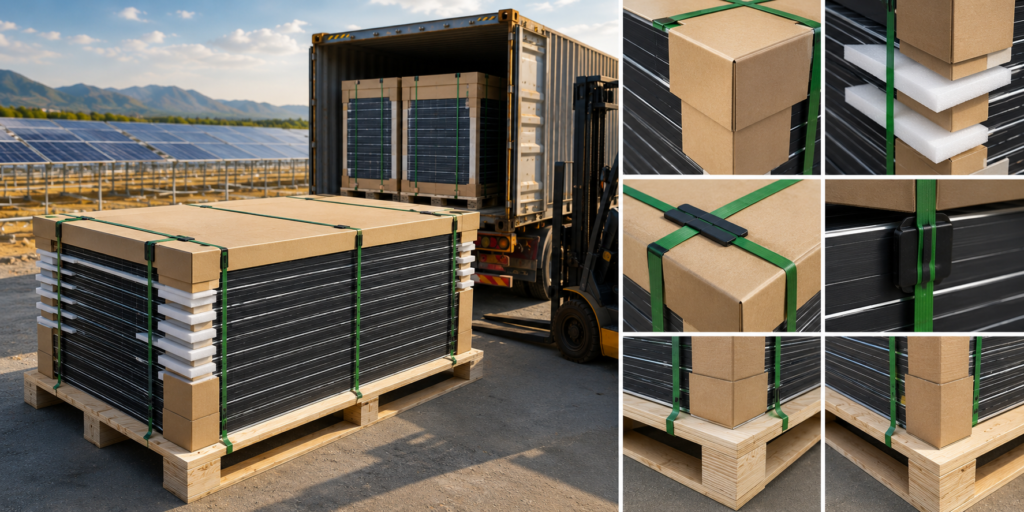
Solar panel packaging is the combination of materials and structural elements built to protect modules from dispatch through transit, storage, and site handling:
- Wooden pallets engineered to carry full-stack loads
- Inter-layer cushioning that stops panels from rubbing or shifting
- Corner and edge protectors at vulnerable impact points
- Moisture barrier film with desiccant packets for humidity control
- Clear handling markings for orientation and stacking limits
The result is panels that arrive ready for installation, without the hidden cell damage that surfaces months later as underperformance.
Common Risks in Solar Panel Shipping
1. Glass Breakage and Microcracks
Tempered glass handles hail and thermal cycling well, but not sustained vibration over hundreds of kilometers of highway. Without proper cushioning between layers, that vibration causes microcracks in cell busbars and interconnects over time.
2. Moisture and Humidity Ingress
Junction boxes, frame seals, and laminate edges are weak points for moisture. Panels can sit at project sites for weeks before installation, and during monsoon months, humidity levels can climb high enough to accelerate delamination if sealing is inadequate.
3. Edge and Corner Impact
A slip from a trolley or a drop from forklift tines usually hits the frame corners first. Even a small impact there can crack the glass nearby, which is why corner protection isn’t optional in a well-packed consignment.
4. Road Vibration Over Long Distances
Solar shipments in India travel mostly by road, often spanning many hours at a stretch. Panels that shift even slightly inside loose packaging pick up abrasion over the journey. Tight-fit packaging that keeps panels from moving is the real fix.
5. Uncontrolled Site Handling
The final stretch from truck to storage area is often where damage happens. Forklifts aren’t always available, so panels get moved by hand or trolley. Clear handling instructions on the package itself are what actually change behavior on a busy site.
Conditions Specific to Indian Solar Projects
Solar manufacturing hubs and project sites in India are often separated by long transit distances, sometimes well over a thousand kilometers, so packaging has to be built for multi-day road journeys, not short local deliveries.
Summer heat adds another layer. A panel sitting in direct sun at a project site during peak summer can face extreme ambient temperatures, and foam densities, adhesive bonds, and polyethylene wrap all behave differently in that heat. Projects are also rarely built in one go. Panels from an early phase may sit on-site for 60–90 days before mounting structures are ready, so packaging needs to hold up against rain, dust, and UV exposure well beyond the transit leg.
Benefits of Engineered Solar Packaging for EPC Teams
Getting solar packaging right delivers returns that go beyond protecting glass and cells:
- Fewer damaged panels: proper cushioning and corner protection prevent the abrasion and impact damage that cause yield loss
- Faster installation readiness: panels arrive in usable condition, without delays from inspection holds or replacements
- Lower long-term risk: preventing microcracks at the packaging stage avoids underperformance that’s nearly impossible to trace back later
- Consistency across consignments: custom packaging built to panel dimensions ensures pallet 500 meets the same standard as pallet one
- Sustainability alignment: recyclable and reduced-waste materials support ESG reporting without compromising protection
Engineering Reliable Solar Packaging with Prime Epaq
Solar panel packaging isn’t just about getting modules from factory to site; it’s about protecting the energy yield a project was designed to deliver. Prime Epaq works with manufacturers, EPC companies, and procurement teams to design packaging matched to panel dimensions, transit routes, and site conditions so consignments arrive intact and installation-ready.
With Prime Epaq, businesses gain a packaging partner who understands the realities of Indian solar logistics, from long road hauls to monsoon humidity to multi-month site storage, and builds protection around them. Together, we can help your project commission on time with the yield it was designed for.
FAQs
1. What is solar panel packaging?
It’s the combination of materials and structural elements, pallets, cushioning, corner protection, moisture barriers, and handling markings used to protect panels from dispatch, transit, storage, and site handling.
2. Why does solar panel packaging matter for large-scale projects?
Transit damage at scale means delayed replacements, disrupted commissioning schedules, and long-term yield loss from cell damage that’s often irreversible once it happens.
3. What are the main damage risks during solar panel shipping?
The primary risks are vibration-induced microcracks, glass breakage from corner impact, moisture ingress during storage, panel-to-panel abrasion, and handling damage at sites without proper equipment.
4. What materials go into quality solar packaging?
Effective packaging typically uses structural wooden pallets, EPE foam or honeycomb cushioning, corner protectors, moisture barrier film, and desiccant packets, all chosen based on the transit route and site conditions.
5. Is custom packaging necessary for solar panels?
For large-scale projects, yes. Panel dimensions vary across manufacturers and wattage ranges, and custom packaging built to specific module dimensions removes the internal movement that causes damage during transit.
6. How does Prime Epaq support solar panel packaging needs?
Prime Epaq works with manufacturers, EPC companies, and procurement teams to design and supply packaging matched to the actual panels, transit routes, and site conditions involved, including engineering, material specification, and bulk consignment consistency.