

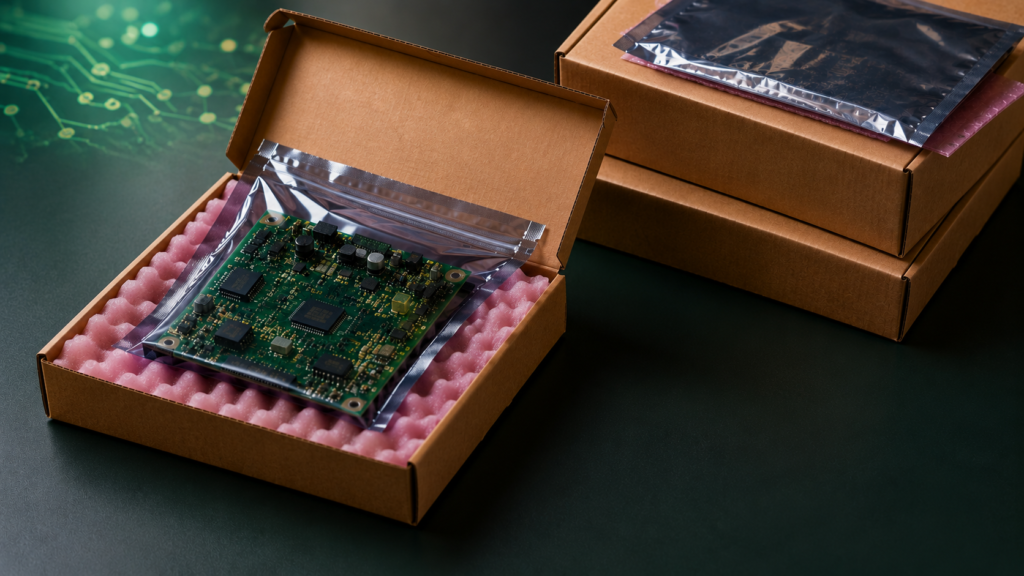
PCB Packaging Solutions for Protection Against ESD and Moisture
A printed circuit board rarely looks damaged even when it has already been compromised. A hairline crack in a trace, a static discharge that weakened a component, or a trace of trapped moisture may not cause a failure on day one. The problem often shows up later, after the board has been installed and shipped to a customer. This is exactly why PCB packaging deserves more attention than it usually gets. It is not simply about wrapping a board and placing it in a box; it is about managing every risk the board faces from the production line to its final installation point.
For electronics manufacturers, EMS companies, and exporters, packaging decisions made just before dispatch can determine whether a shipment arrives fully functional or returns as a warranty claim. This guide covers the real risks PCBs face in transit and storage, and the practical packaging choices that keep boards safe from the first handling step to final delivery.
Why Printed Circuit Boards Need More Than Standard Packaging
Printed circuit boards are not built to survive rough handling. The copper traces, solder joints, and mounted components are all sensitive to forces that a standard cardboard box and a layer of bubble wrap will not stop. A board can be damaged by something as invisible as a static charge from a person’s hand or as gradual as humidity settling into a warehouse over a few weeks of storage.
Consider the range of risks a single board faces on a normal journey from a production facility to an end customer:
- Electrostatic discharge (ESD) from handling, packaging materials, or work surfaces
- Moisture absorption during storage or humid transit routes
- Corrosion on exposed copper, pads, and connectors
- Vibration and shock from road transport and warehouse handling
- Scratches and surface damage from rubbing against packaging or other boards
- Bending and warpage from improper stacking or pressure
- Dust and contamination during open storage or transit through multiple facilities
- Component damage from impact, especially on assembled boards with tall parts
None of these risks acts alone. A board that has already absorbed some moisture is more prone to corrosion during a vibration-heavy truck journey, which is why serious PCB packaging is designed around the full journey, not a single stage of it.
What Makes PCB Packaging Different?
It is tempting to think of printed circuit board packaging as a smaller version of general product packaging. In practice, it works on a different set of rules. A board does not just need protection from breaking; it needs protection from static charges it cannot dissipate on its own, from humidity it cannot resist once trapped inside a bag, and from movement inside a box that a general product would tolerate without issue.
Proper packaging for printed circuit boards typically brings together several layers working at once: an ESD-safe inner layer, a moisture control layer suited to storage duration and route, cushioning that holds the board firmly without pressing on components, an outer box strong enough for expected handling and stacking, and clear labelling that tells every handler how the package should be treated.
The design also changes with the route. A board shipped by air to a domestic customer faces different risks than one shipped by sea freight through several climate zones, and good packaging accounts for that instead of applying the same box and bag combination to every shipment.
The Three Main Threats to PCBs During Shipping
Nearly every case of PCB shipping damage traces back to one of three root causes. Understanding each one clearly is the first step toward preventing it.
ESD Damage
Electrostatic discharge happens when a static charge, built up on a person, a surface, or certain packaging materials, suddenly transfers into the board. Many components on a modern PCB, particularly integrated circuits and sensitive semiconductors, can be affected by discharges far too small for a person to feel.
What makes ESD frustrating for quality teams is that the damage is not always immediate. A board can pass functional testing right after an ESD event and still fail weeks later in the field, once the weakened component finally gives out. This delayed failure pattern is why ESD protection has to be built into packaging rather than treated as optional.
Moisture and Corrosion
Moisture is a slower but equally damaging threat. Bare copper oxidises when exposed to humidity, and trapped moisture inside packaging can lead to corrosion on pads, connectors, and exposed traces. Condensation is a particular risk when a shipment moves between climate zones, for example from a cooler storage facility into a warm, humid destination port.
Poor storage conditions compound the problem. A board left in a warehouse without climate control, even briefly before dispatch, can begin absorbing moisture long before it is packed for transit.
Shock, Vibration, and Handling Stress
The third major threat is physical stress from handling, transport, and storage. Road transport exposes packages to constant vibration, warehouse handling introduces drops and rough stacking, and loose packing, where a board has room to shift, turns ordinary transit vibration into repeated impacts against the box walls.
Last-mile delivery adds another layer of risk, since packages at this stage often pass through multiple handlers who may not know the contents are sensitive electronics.
How to Protect PCBs from ESD Damage
Effective ESD protection starts at the point the board leaves the production line and continues through every handling step until installation. A reliable approach typically includes:
- ESD shielding bags, built with a metalised layer that creates a Faraday cage effect around the board
- Anti-static bags for lower-risk handling and short-term internal movement
- Conductive foam for cushioning that also helps dissipate static charge
- Static dissipative trays for assembled boards or multi-board shipments
- ESD-safe bubble wrap, distinct from standard bubble wrap, for additional cushioning without introducing static risk
- Conductive corrugated packaging for outer boxes used in ESD-controlled environments
- Clear ESD warning labels on the outside of the package
- A grounded handling process at every stage where the board is touched, packed, or moved
Standard plastic bags, regular bubble wrap, and ordinary foam should never be used for ESD-sensitive boards. These materials are often insulators and, in some cases, can actually generate static charge through friction, which increases risk rather than reducing it.
How to Protect PCBs from Moisture and Humidity
Moisture protection should be planned around storage time, shipping route, climate, and export requirements, not applied the same way to every order. A board sitting in a controlled facility for a few days has very different needs than one travelling by sea freight through humid ports over several weeks.
- Moisture barrier bags, heat-sealed to keep external humidity from reaching the board
- Vacuum sealing for long-duration storage or high-humidity export routes
- Desiccant packs sized correctly for the sealed bag volume
- Humidity indicator cards that let receiving teams verify the internal environment stayed dry
- VCI (vapour corrosion inhibitor) films for additional corrosion protection on exposed metal surfaces
- Proper heat sealing rather than folded or taped closures, which allow humidity to seep in over time
- Dry, climate-controlled storage conditions before packaging even begins
Getting packaging for printed circuit boards right on the moisture side usually comes down to matching barrier strength and desiccant quantity to the actual shipping duration, rather than using the same standard setup regardless of route or season.
How to Prevent Physical Damage During PCB Shipping
Physical damage prevention works on two levels at once: what protects the board directly, and what protects the package as a whole. Strong outer packaging with poor inner cushioning still allows the board to move and collide with its own container.
- Correctly sized boxes that avoid excess internal space where a board could shift
- Strong corrugated structure rated for the expected stacking and handling conditions
- Internal partitions to separate multiple boards in the same shipment
- Board separators that prevent direct contact between boards
- ESD-safe foam inserts shaped to hold the board firmly without pressure on components
- Cushioning support on all sides, not only the top and bottom
- Edge protection to prevent chipping or cracking at board corners
- Adequate stacking strength so lower boxes are not crushed under pallet weight
- Clear handling labels so warehouse and courier staff treat the package appropriately
Custom PCB Packaging for Safe Transport
Standard packaging works reasonably well for simple, low-risk shipments. It starts to fall short once boards become more sensitive, more valuable, or more complex in shape. This is where custom PCB packaging for safe transport becomes a practical necessity rather than a premium add-on.
- Custom foam inserts shaped to the exact outline of the board
- ESD-safe trays designed for stacking multiple boards without contact damage
- Corrugated partitions built around specific board dimensions
- Moisture barrier systems sized to the actual packed volume
- Export-ready cartons that meet international handling and documentation requirements
- Product-specific packaging design rather than a generic, one-size-fits-all approach
- Packaging decisions based on component height, board size, weight, fragility, storage duration, and the actual transit route
The value of custom PCB packaging for safe transport becomes clearest with high-value assemblies, export orders, or boards with tall or delicate mounted components, where a standard box and generic foam simply cannot provide the level of fit and protection the product needs.
Practical PCB Packaging Checklist Before Dispatch
Before any PCB shipment leaves a facility, running through a short checklist can catch the gaps that lead to avoidable damage claims.
- PCB inspected before packing
- ESD-safe handling used throughout the packing process
- Board packed in an ESD-safe bag appropriate to its sensitivity level
- Moisture barrier added if the route or storage duration requires it
- Desiccant and humidity indicator card included where moisture protection applies
- Cushioning or tray support added to prevent movement inside the box
- Correct shipping box selected for the board size, weight, and handling conditions
- Package sealed properly with no gaps or weak closures
- ESD, fragile, keep-dry, and handling labels added clearly on the outside
- Final dispatch check completed before the shipment leaves the facility
Common PCB Packaging Mistakes That Lead to Damage
Most PCB shipping damage traces back to a handful of repeated packaging mistakes:
- Using regular plastic bags instead of proper ESD-safe materials
- Using normal bubble wrap with no anti-static properties
- Ignoring moisture protection on humid routes or long storage periods
- Leaving space inside the box that lets the board shift in transit
- Using weak, thin cartons that cannot handle stacking or rough transport
- Stacking multiple boards without separators between them
- Skipping ESD and handling labels, inviting careless treatment down the supply chain
- Applying the same packaging to every PCB type regardless of sensitivity or value
- Skipping a final packaging check before dispatch
What to Look for in a PCB Packaging Partner
Businesses that ship PCBs regularly eventually need a packaging partner rather than handling everything in-house. A few things are worth checking before committing to one:
- Genuine experience in electronic PCB packaging, not just general industrial packaging
- Ability to design custom packaging rather than offering only standard box sizes
- Solid working knowledge of ESD-safe materials and when each one applies
- A range of moisture and corrosion protection options suited to different routes
- Strong inner and outer packaging design, not just a focus on the outer carton
- Export-ready packaging capability for international shipments
- Support for both bulk production runs and smaller repeat shipments
- A willingness to match packaging to the product’s dimensions, handling risks, and route
Safe PCBs Start with Smarter Packaging
Protecting a printed circuit board during storage and transport is not about spending more on packaging. It is about spending correctly on the specific combination of ESD protection, moisture control, cushioning, and box strength that a particular board and shipping route actually require. A board with tall components needs different clearance than a bare board. An export shipment through humid ports needs stronger moisture control than a short domestic delivery.
Getting this right consistently, across different board types, order volumes, and shipping routes, usually comes down to having a clear packaging process and materials matched to each product rather than a single generic setup applied to everything that goes out the door.
Businesses shipping PCBs regularly, whether bare boards, assembled modules, or export orders, can benefit from consulting a professional industrial packaging provider to design a PCB packaging approach suited to their specific products, volumes, and transit routes.
FAQ
1. What is PCB packaging?
PCB packaging refers to the combination of materials and design used to protect printed circuit boards during storage, handling, and transport. It typically includes ESD-safe inner packaging, moisture control materials, cushioning, and a suitably rated outer box, all matched to the board’s sensitivity and shipping route.
2. Why is ESD protection important for printed circuit boards?
Many components on a PCB can be damaged by static discharge levels too small for a person to feel. This damage is not always immediate, and a board can pass initial testing before failing later in the field. ESD-safe packaging prevents static charges from reaching the board in the first place.
3. What is the best packaging for printed circuit boards?
There is no single best solution, since the right packaging depends on board sensitivity, value, and shipping route. In general, reliable packaging for printed circuit boards combines an ESD-safe bag, moisture protection where needed, firm cushioning, and a correctly sized, strong outer box.
4. Can regular plastic bags be used for PCBs?
No. Regular plastic bags do not provide ESD protection and can, in some cases, generate static through friction. ESD-sensitive boards should always be packed in proper anti-static or ESD shielding bags instead.
5. How do moisture barrier bags protect printed circuit boards?
Moisture barrier bags are heat-sealed to prevent external humidity from reaching the board. When combined with desiccant packs and a humidity indicator card, they keep the internal environment dry throughout storage and transit, reducing the risk of corrosion and moisture-related failures.
6. What are PCB shipping boxes?
PCB shipping boxes are outer cartons designed specifically for transporting circuit boards. They are typically rated for higher stacking and handling strength than general-purpose boxes and are used alongside internal cushioning, partitions, and ESD-safe materials to form a complete protective package.
7. What is the difference between bare PCB packaging and assembled PCB packaging?
Bare PCBs mainly need protection from ESD, moisture, and bending. Assembled PCBs carry mounted components, which adds the risk of impact damage, so their packaging needs cushioning that prevents movement without applying pressure directly on components.
8. Why is custom PCB packaging for safe transport important?
Custom packaging is designed around the exact board dimensions, component height, weight, and transit route, rather than forcing the product into a generic box. This becomes especially valuable for high-value assemblies, export shipments, and boards with unusual shapes or tall components.
9. How should PCBs be packed for export shipping?
Export shipments generally need stronger moisture protection due to longer transit times and varying climate conditions, along with export-ready cartons, proper ESD protection, and secure cushioning to withstand multiple handling points across ports and carriers.
10. What should businesses look for in electronic PCB packaging?
Businesses should look for packaging that combines genuine ESD-safe materials, appropriate moisture and corrosion protection, well-designed cushioning, a correctly rated outer box, and clear handling labels, all matched to the specific board type and shipping route rather than a one-size-fits-all setup.