

Medical Device Packaging Solutions
Think about everything a medical device goes through before it reaches the hospital, clinic, or lab where it will be used. It is packed, loaded onto a truck, transported on Indian roads, stacked in a warehouse, sometimes transferred to another vehicle, and finally unloaded at its destination. By the time it arrives, it has gone through several stages of handling and transportation, even though the people receiving it may not see any of it.
For most products, a little rough handling may not be a major concern. For medical devices, however, it can affect whether the machine works properly when it is first used or needs to be repaired. A cracked housing, a sensor that has moved out of calibration, or static damage to a circuit board may not be visible from the outside. The problem may only become clear when the device is switched on. That is what makes medical device packaging different. It needs to protect against damage that is not immediately visible.
Why You Can’t Treat Medical Equipment Like a Standard Shipment
Medical device manufacturers are not shipping a single product. A portable diagnostic tool, a hospital imaging system, and a lab instrument all behave differently in transit, and each one comes with its own weight, fragility, and handling needs. A packaging format that works well for one can be completely wrong for another.
There is also less room for error here than in most industries. Many of these devices carry electronics, sensors, or precision-calibrated parts that react badly to vibration, compression, or a sudden knock. Add in the fact that shipments often travel long distances, sometimes across very different climates, and you start to see why packaging needs to be planned around the device rather than picked off a shelf.
What Engineered Medical Device Packaging Actually Needs to Do
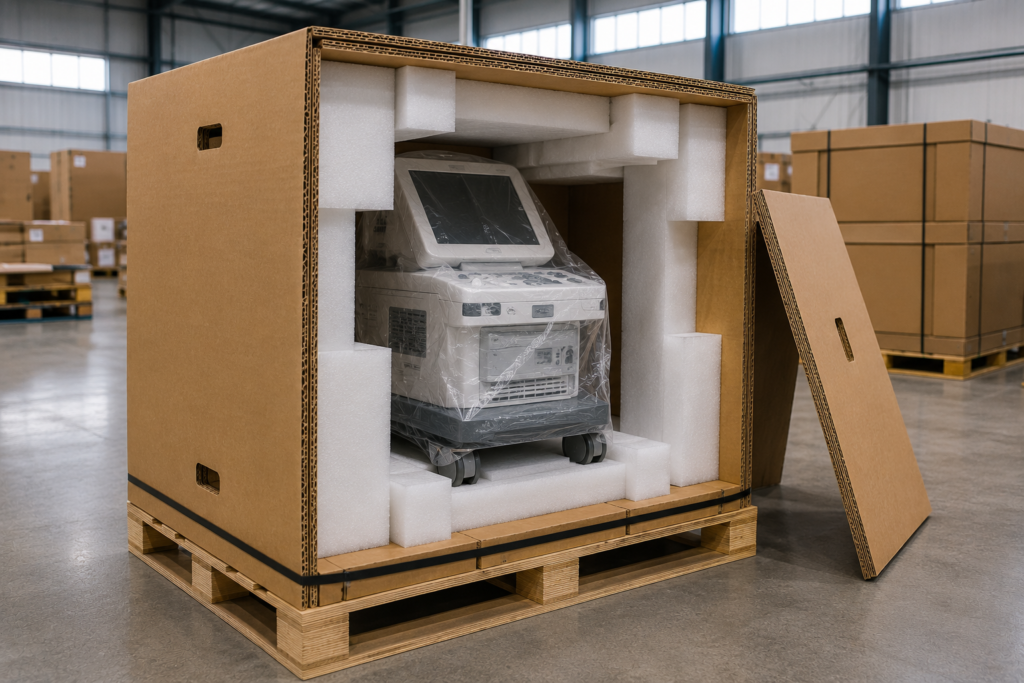
Absorb shock instead of passing it on. Devices with moving parts or internal electronics need packaging that cushions them, not packaging that just holds them in place. Foam inserts, corrugated partitions, and custom-fit cavities keep the device from shifting around inside the box during transit.
Keep electronics safe from static. A lot of medical equipment runs on circuit boards, sensors, or digital displays, and these are genuinely vulnerable to electrostatic discharge. Anti-static bags and conductive foam handle this quietly in the background, but skipping this step is one of the easier ways to end up with a device that looks fine and simply does not work.
Account for humidity. Moisture is an underrated risk, especially with monsoon season or shipments crossing different climates. Moisture-barrier materials and desiccants help keep the internal environment stable so components are not sitting in dampness they were never designed for.
Give larger equipment real structural support. Bigger devices, like imaging and diagnostic machines, need rigid outer packaging, usually wooden crates or engineered wood structures, so they do not flex or get crushed when stacked or moved with a forklift.
Hold up over longer, more complicated journeys. Medical devices often travel across state lines or international borders, passing through several hands along the way. Packaging needs to survive that entire chain, not just the first leg of it, and still meet whatever documentation or material standards the destination requires.
How We Approach This at Prime Epaq
We do not start with a standard packaging format and try to make the device fit into it. We start with the device itself, its weight, its dimensions, what is fragile about it, and where it is headed, and build the packaging around that. Depending on what the equipment needs, that might mean corrugated board, engineered wood, ESD-safe materials, or some combination of all three.
For manufacturers who want packaging built into their production line rather than added on afterward, our on-site and turnkey services can plug directly into that process, ensuring the protection is in place before the device ever leaves the facility.
Engineered medical device packaging is not really about the box. It is about making sure equipment that took real engineering to build actually works the moment it reaches the customer. Get it right, and you spend less time dealing with damage claims and a lot more time on the things that actually grow your business.
If you manufacture medical devices and want packaging built around how your equipment actually needs to travel, get in touch with our team.