

Eco-Friendly Packaging for Industrial Shipments
Every packaging conversation eventually gets to the same question: can we make this more sustainable without making it weaker? For a lot of products, the answer is yes without much thought. For something like a solar inverter, an automotive assembly, or anything crossing a border on a pallet, the answer needs more than good intentions. It needs a material that can actually take the hit.
That’s the real challenge with eco-friendly packaging for industrial shipments. It can’t just be recyclable or biodegradable. It has to survive the same shock, moisture, and handling as conventional packaging, or it isn’t actually saving anything.
What Eco-Friendly Actually Means for Industrial Shipments
For consumer goods, eco-friendly usually means a recyclable mailer or compostable wrap. Industrial and export shipments ask for more than that. The packaging still has to:
- Hold up under the same load, vibration, and handling as conventional packaging
- Cut material waste without cutting protection
- Be reusable across several shipments, not just recyclable after one
- Meet EPR (Extended Producer Responsibility) requirements and hold up to audits
- Fit into a circular model, where the packaging comes back into use instead of ending up in landfill
If it checks the first box but fails the rest, you end up spending more on damage claims than you saved on sustainability.
How We Do This Without Cutting Corners on Protection
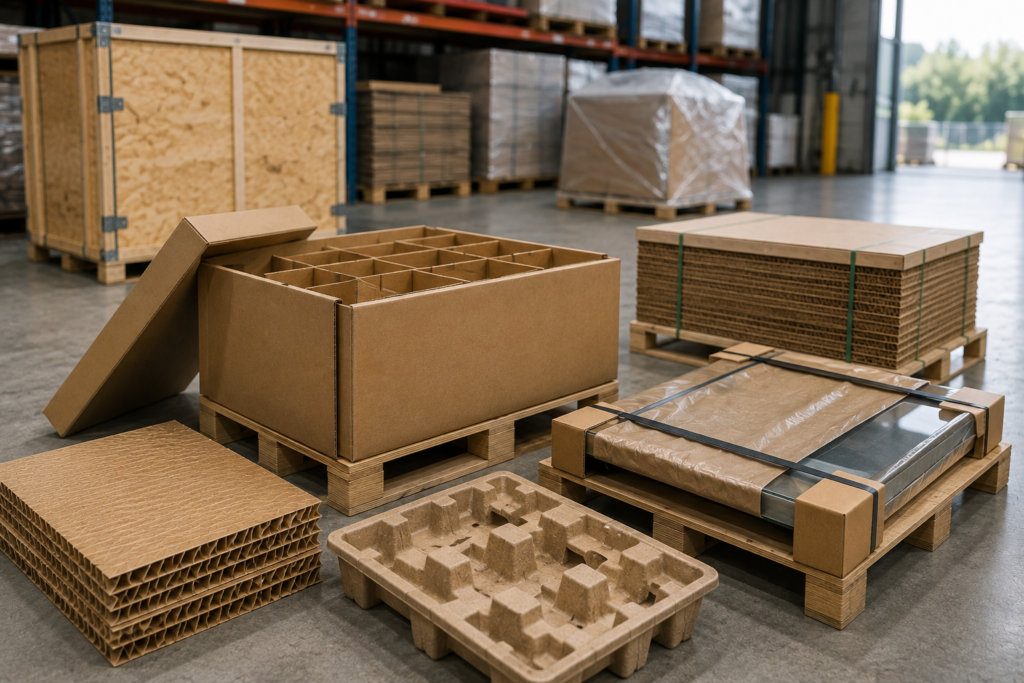
Recyclable and reusable fiber: Corrugated, honeycomb, and recyclable fiber hold up close to foam and plastic in terms of strength and cushioning, and they’re fully recyclable. Honeycomb especially has been replacing wood in a lot of applications we work on, since it cuts weight and material without giving up structure.
Reusable pallets and containers: Recycled plastic pallets and modular containers are built to go through multiple shipment cycles rather than getting used once and thrown out. If you’re shipping to the same sites or warehouses repeatedly, this is usually where the cost and waste savings show up fastest.
Bio-based coatings: Our BioGuard coatings are made from vegetable oil rather than petroleum, and they hold up against moisture just as well while breaking down naturally at end of life.
OSB and plywood instead of solid timber: When wood packaging is needed, OSB and plywood give the same strength and export readiness as solid timber, with less environmental impact per shipment.
Getting the size right in the first place. A lot of packaging waste has nothing to do with the material and everything to do with an oversized box or too much void fill. We work through dimensions during design and prototyping before we even get to material choice, so we’re not trying to fix a bad box with a greener one.
Where This Makes the Biggest Difference
- Solar manufacturers exporting modules and BOS components at scale
- Automotive suppliers moving components across long domestic and export routes
- FMCG and consumer goods brands dealing with tightening EPR rules
- Anyone shipping repeatedly to the same sites, where reusable packaging pays for itself fastest
Questions We Get Asked Often
Does eco-friendly packaging cost more?
Not necessarily. Reusable systems often work out cheaper over multiple shipments, and getting the size right cuts material cost regardless of what it’s made from. It really comes down to your product, your materials, and how often you’re shipping, which is why we look at it as one decision rather than a simple swap.
Can it actually protect as well as foam or plastic?
Yes, when it’s engineered properly. Honeycomb, corrugated fiber, and bio-based coatings match up well against conventional materials for most industrial use cases. The exceptions are certain high-vibration or very humid routes, and we look at those case by case.
How does this help with EPR compliance?
EPR comes down to tracking what materials you’re using, whether they’re recyclable, and what happens to them at end of life. We build that into material selection and reporting from the start instead of trying to bolt it on later.
Let’s Build It In From the Start
Eco-friendly packaging works best when it’s part of the design from day one, not something swapped in later. Tell Prime Epaq about your product, your shipment volume, and what you need for compliance, and we’ll put together a packaging system that protects the shipment and holds up to your sustainability goals.