

How Do Automotive Packaging Solutions Improve Supply Chain Efficiency?
Every vehicle, engine, or battery pack that leaves a manufacturing plant travels through a long chain of vendors, warehouses, transport carriers, ports, and assembly lines. At each stage, components face vibration, humidity, rough handling, and stacking pressure. A single damaged gearbox housing or a corroded body panel can delay a production line, trigger rework costs, or cause a shipment rejection at the customer’s dock. This is exactly where automotive packaging solutions stop being a dispatch formality and start functioning as a core part of supply chain protection.
For OEMs, EV manufacturers, and Tier 1 and Tier 2 suppliers operating in India’s competitive manufacturing environment, packaging decisions directly affect cost, delivery timelines, and component quality. This blog breaks down what manufacturers actually need to know — from material selection to EV battery protection to export readiness — so packaging stops being an afterthought and starts working as a planned part of the production process.
What Are Automotive Packaging Solutions?
Automotive packaging solutions are engineered systems tailored to the specific characteristics of a component, its size, weight, fragility, handling method, expected storage duration, and transport route. Unlike generic industrial packaging, automotive-grade packaging accounts for variables such as vibration during road transport, humidity exposure during sea freight, static sensitivity in electronic assemblies, and repeated handling cycles in closed-loop supply chains.
A well-designed packaging system is built backwards from the risk profile of the part, not forward from a standard box size.
Why Automotive Packaging Matters in Modern Manufacturing
Automotive components are precision-engineered, often expensive, and frequently sensitive to moisture, static charge, or physical impact. When packaging fails, the cost shows up in several ways:
- Component damage during transit or warehouse handling, leading to scrap or rework
- Production line stoppages when a replacement part doesn’t arrive on time
- Corrosion on machined surfaces, especially during monsoon storage or sea freight
- Safety risks when heavy parts are improperly secured on pallets or skids
- Export rejections when packaging doesn’t meet destination-country compliance standards
Reliable automotive packaging solutions address all five risks at once, which is why procurement and supply chain teams are increasingly involving packaging engineers early in sourcing decisions rather than treating packaging as a last-minute purchase.
Packaging of Automotive Parts: What Needs Protection?
Different automotive components carry different risks, and the packaging of automotive parts has to be designed component by component rather than as a one-size-fits-all solution.
Engines, Gearboxes, and Powertrain Assemblies
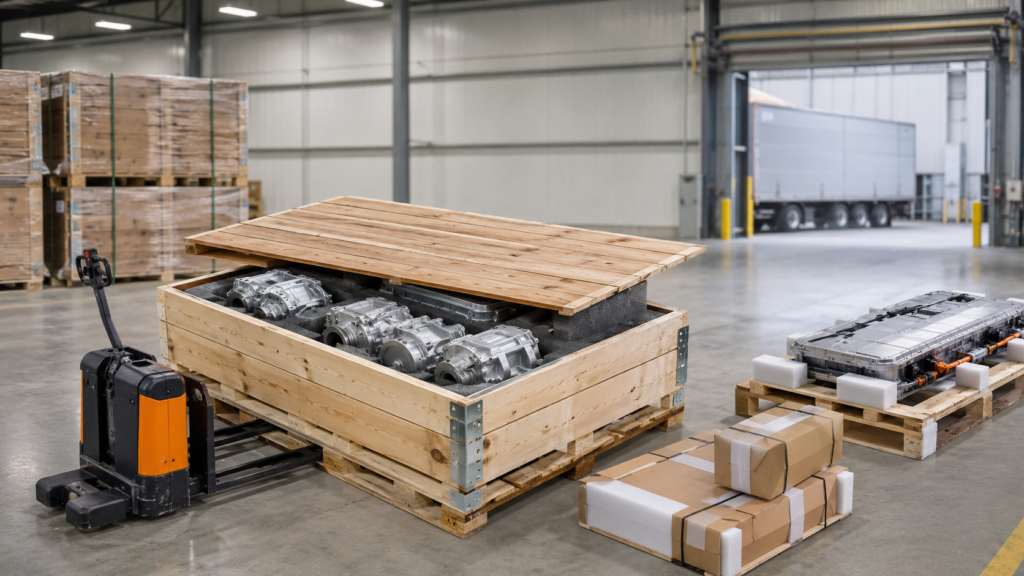
These are heavy, often oily, and precision-machined. They typically require reinforced wooden crates or skids with internal bracing, anti-vibration cushioning, and corrosion-inhibiting wraps to protect machined surfaces from rust during transit or storage.
EV Batteries and Power Systems
Battery packs and modules need fire-resistant liners, ESD-safe materials to prevent static discharge, and impact-resistant outer structures. Thermal stability during storage is also a factor, particularly in regions with high ambient temperatures.
Body Panels and Painted Surfaces
Scratches and dents on painted or coated surfaces are difficult to repair without affecting finish quality. Foam interleaving, EVA/EPE padding, and rigid separators prevent panel-to-panel contact during transport.
Electronics, Sensors, and Wiring Systems
ESD-safe liners and anti-static films are essential here, since even minor static discharge can damage circuit boards or sensor calibration.
Export-Ready Automotive Packaging for Long-Distance Transit
Export shipments face risks that domestic transport doesn’t including extended transit times, sea freight humidity, multiple port-handling stages, and destination-country compliance requirements. Export-ready packaging typically includes:
- Moisture-resistant barriers to counter condensation inside sea containers
- Corrosion prevention through VCI films and sealed wraps
- Reinforced crates built to withstand stacking and repeated handling
- Skids and palletisation designed for forklift and crane compatibility at ports
- Fumigation-compliant wooden packaging (ISPM-15 standard) for international shipments
- Documentation readiness, including packing lists and compliance certificates that align with customs requirements
A packaging failure during export is costlier than a domestic one; replacement parts take longer to source, and customer trust takes longer to rebuild.
Why Prime Epaq for Automotive Packaging Solutions?
We design packaging systems around the specific handling, protection, and compliance needs of automotive components from complete vehicles and EV batteries to engines, powertrain assemblies, body panels, and interiors. Our approach covers wooden crates, OSB structures, corrugated packaging, skids, pallets, VCI films, EVA/EPE foams, ESD-safe liners, fire-resistant liners, and reusable packaging systems, built around each component’s risk profile rather than a standard catalogue size.
For manufacturers exporting components or vehicles, we also account for moisture protection, corrosion prevention, and export documentation requirements to reduce the risk of in-transit damage or compliance delays. You can explore our full range of automotive packaging solutions for OEMs, EV manufacturers, and component suppliers.
Move Automotive Parts Safely from Plant to Destination
Automotive packaging is no longer a step that happens after production; it’s a system that protects production timelines, component value, and supply chain reliability from the first mile to the last. Whether it’s an EV battery requiring thermal and ESD protection, a gearbox needing corrosion control, or an export shipment requiring moisture-resistant, compliance-ready crating, the right automotive packaging solutions reduce risk at every handling point.
If your team is evaluating packaging for a new component line, an EV program, or an export market, it’s worth speaking with a packaging partner who understands automotive supply chains in detail. Connect with Prime Epaq to discuss custom automotive packaging solutions built around your components, routes, and production schedules.
FAQs
1. What are automotive packaging solutions?
Automotive packaging solutions are engineered packaging systems designed to protect vehicle components from engines to EV batteries during handling, storage, and transport. They are built around a component’s weight, fragility, and transport route rather than standard packaging formats.
2. Why is the packaging of automotive parts important?
Packaging of automotive parts prevents physical damage, corrosion, and contamination during transit and storage. Poor packaging can lead to production delays, rework costs, and shipment rejections, especially for precision-machined or electronic components.
3. What materials are used for automotive packaging?
Common materials include wooden crates, OSB structures, corrugated boxes, pallets, skids, EVA/EPE foams, VCI films, moisture barriers, ESD-safe liners, and thermal protection layers, selected based on the component’s sensitivity and handling needs.
4. How do I choose the right automotive packaging suppliers?
Look for suppliers with custom design capability, automotive component knowledge, export packaging experience, prototyping support, bulk supply capacity, and sustainable packaging options, rather than those offering only standard industrial packaging.
5. Can automotive packaging be customised for EV batteries and heavy components?
Yes. EV batteries require fire-resistant, ESD-safe, and thermally stable packaging, while heavy components like engines and gearboxes need reinforced crates with vibration control and corrosion protection. Packaging suppliers should be able to design around both requirements.