

Aerospace Packaging for High-Value Components
Aerospace components are expensive, precise, and unforgiving of damage. A single scratch on a sensor housing or a dent on a structural bracket can mean rework, delays, or a part being scrapped entirely. This is why aerospace packaging is treated as an engineering problem, not an afterthought. The right packaging protects the part, meets the buyer’s requirements, and gets the shipment through handling, storage, and transit without surprises.
Why Aerospace Packaging Is Different From Standard Industrial Packaging
Most industrial packaging is built to survive normal handling and get the product from point A to point B in reasonable shape. Aerospace packaging has to do more.
The cost of getting it wrong
Damage to an aerospace part rarely stays a small problem. A dented panel or a contaminated avionics unit can trigger inspection holds, rejected shipments, and missed production schedules further down the line. For parts that feed into aircraft assembly or maintenance programs, a delay of even a few days can ripple through an entire production line. That is why buyers in this industry are far less price sensitive on packaging than buyers in most other sectors. They are paying for certainty.
What makes aerospace components hard to package
Aerospace parts vary enormously, from tiny electronic connectors to fuselage sections that need a flatbed truck. What ties them together is that most are
- High in value relative to their size and weight
- Sensitive to shock, vibration, moisture, or static
- Precision machined, so even minor surface damage affects fit or function
- Subject to strict handling and storage conditions before they reach the aircraft or the customer
This combination means aircraft parts packaging cannot be generic. Every part needs to be assessed individually for its fragility, weight distribution, and sensitivity before a packaging design is finalized.
Choosing the Right Packaging Material for Aerospace Components
There is no single best material for aerospace packaging. The right choice depends on the part’s weight, value, sensitivity, and how it will move through the supply chain.
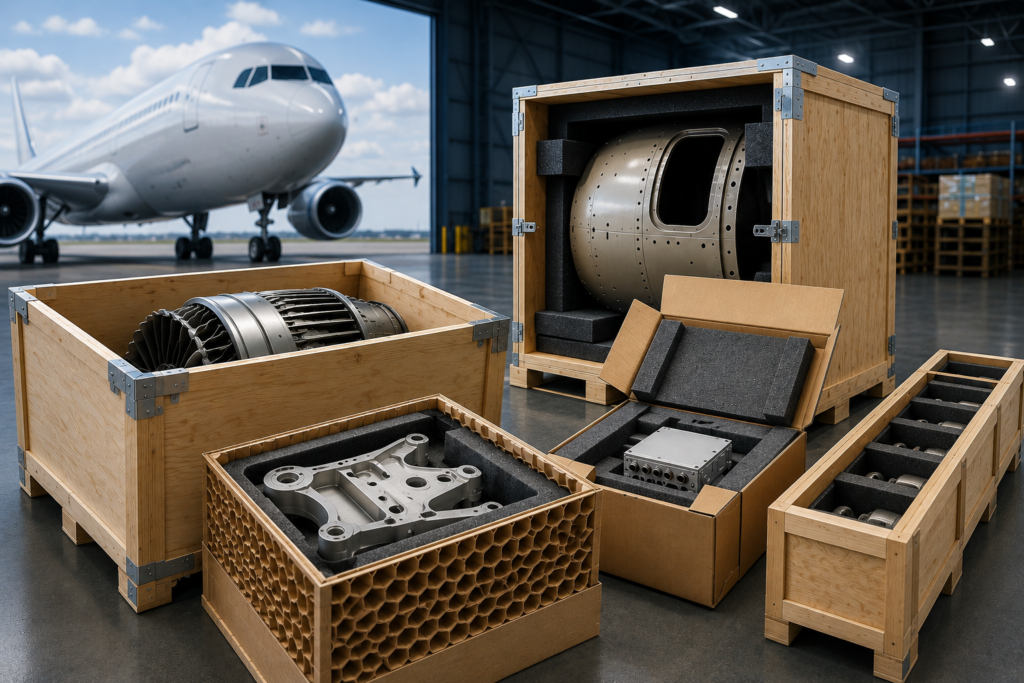
Wooden crates and nail-less boxes
For structural parts, machined components, and heavier assemblies, wooden crates remain a dependable choice. Nail-less boxes are worth calling out specifically here. Traditional wooden boxes use nails and staples that can work loose in transit and scratch or puncture whatever is inside. Nail-less construction removes that risk while still giving the load-bearing strength that heavier components need.
Honeycomb packaging
Honeycomb packaging has become a strong option where weight matters as much as protection. It offers good cushioning and structural rigidity while weighing a fraction of solid board or wood, which helps control freight costs on large shipments. It also tends to be easier to recycle, which is increasingly a factor buyers ask about.
Foam and cushioning systems
For delicate, precision, or electronic components, foam inserts are usually the answer. Custom cut foam holds a part in a fixed position inside its outer container, absorbing shock and vibration so the component never makes contact with a hard surface. This is especially important for anything with tight tolerances or exposed connectors.
Corrugated and engineered board
Not every aerospace part needs the heaviest protection available. For lower-risk components, spares, or items that are already individually protected before packing, corrugated and engineered board options offer a cost-effective way to ship without over-engineering the packaging.
Protection Beyond the Box: Engineering Considerations
Choosing a material is only part of the job. The packaging design also has to account for the specific ways a part can be damaged in transit.
Anti-static and ESD protection
Avionics units, circuit boards, and other electronic assemblies can be damaged by static discharge that is completely invisible to the naked eye. Anti-static bags, foams, and shielding materials are built into the packaging to prevent this, and this step is non-negotiable for anything with sensitive electronics inside.
Moisture barriers and corrosion prevention
Long transit times, humid ports, and extended storage can all introduce moisture into a shipment. Barrier films, desiccants, and vapor corrosion inhibitors are used to keep metal components from corroding and to protect anything sensitive to humidity.
Vibration and shock resistance
Every mode of transport, road, rail, sea, or air, introduces its own vibration and shock profile. Packaging needs to be designed and, where possible, tested against these conditions so the part arrives exactly as it left the factory.
Packaging for oversized and structural components
Larger items such as panels, brackets, or partial assemblies need custom crating with proper weight distribution and floater bases so the part is not resting on a single stress point. This is where the packaging design has to be worked out almost like a small engineering project of its own.
Sustainability in Aerospace Packaging
Sustainability has moved from a nice-to-have into an actual requirement for many aerospace buyers, especially those with their own environmental commitments to meet.
Recyclable and biodegradable material options
Wherever performance requirements allow, recyclable board, honeycomb, and biodegradable cushioning materials are being used in place of plastic foam and non-recyclable composites. The performance does not have to be compromised for this to work, it just needs to be planned into the design from the start rather than added on afterward.
Reusable and returnable packaging systems
For buyers who repeatedly ship the same type of component, returnable packaging systems can significantly reduce both costs and waste over time. A well-built wooden crate or a reinforced case can go through dozens of shipping cycles if it is designed for reuse from day one.
How to Choose an Aerospace Packaging Partner
Not every packaging supplier is set up to handle aerospace work, and picking the wrong one usually shows up as damage claims or missed deadlines later.
Questions to ask before signing a vendor
- Have they packaged similar components before, and can they show it
- Can they design and test packaging for your specific part, not just supply a standard box
- Do they understand the handling and storage conditions your shipment will go through
- Can they scale from a single prototype shipment to full production volume
- Do they offer sustainable material options without compromising protection
Why manufacturing and compliance expertise matter more than price
A supplier who understands aerospace packaging solutions end to end, from material selection to design to production, is protecting your product and your timeline, not just filling a box. That expertise is worth paying for.
A Packaging Approach Built Around Your Component
Aerospace packaging is not something to standardize across every shipment. Every component has its own weight, value, and sensitivity, and the packaging around it needs to reflect that. Whether you are shipping a single precision part or setting up a returnable packaging system for a production line, working with a partner who understands aerospace packaging solutions from material selection through to final delivery makes the difference between a shipment that arrives exactly as it left and one that ends up as a damage claim.
If you are looking for a packaging partner who can design and build protection around your aerospace components, Prime Epaq can help you get it right from the first shipment.
Frequently Asked Questions
What packaging materials are best for aerospace components?
It depends on the part. Wooden crates and nail-less boxes work well for heavier structural parts, honeycomb suits large but weight-sensitive shipments, foam is best for delicate or electronic components, and corrugated board is a practical choice for lower-risk items.
Why do aerospace components need anti-static protection?
Many aerospace parts contain sensitive electronics that can be damaged by static discharge without any visible sign of it happening. Anti-static bags, foams, and shielding materials prevent this during handling and transit.
Is ISPM 15-certified wood packaging required for exporting aerospace parts from India?
Yes, wood packaging material used for international shipments generally needs to be ISPM 15-certified, which means it has been heat-treated or fumigated to prevent the spread of pests across borders.
How much does custom aerospace packaging cost?
Cost depends on the size, weight, and sensitivity of the component, the materials used, and whether the packaging is designed for single use or multiple reuse cycles. A properly engineered solution costs more upfront than generic packaging but saves money by avoiding damage and delays.
Can aerospace packaging be reusable or returnable?
Yes. For components shipped repeatedly, returnable crates and cases are often designed to withstand dozens of cycles, which reduces both cost and waste over time compared to single-use packaging.
How do you choose the right aerospace packaging manufacturer?
Look for a manufacturer with direct experience packaging similar components, the ability to design and test packaging around your specific part, and the capacity to scale from prototype quantities to full production volumes.