

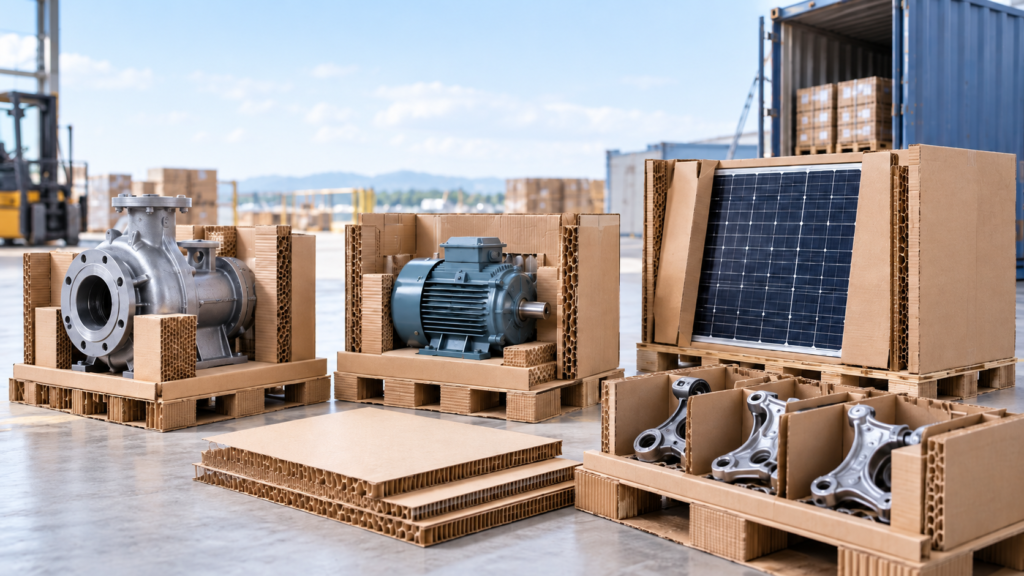
Honeycomb Packaging for Industrial and Export Shipments
Shipping pumps, motors, automotive components, solar equipment, or industrial machinery overseas requires packaging that can protect the product without adding unnecessary weight or complexity.
Wooden crates and pallets are widely used because of their strength, but they also increase shipment weight and may require ISPM-15 treatment for export.
For many industrial applications, honeycomb packaging offers a lighter and more flexible alternative. Depending on the product weight, handling conditions, and transportation requirements, it can be used on its own or as part of a hybrid packaging system.
What Is Honeycomb Packaging?
Honeycomb packaging is made from kraft paper formed into a hexagonal cell structure and bonded between outer paper layers.
This structure helps distribute pressure across the material and provides good compression strength while keeping the packaging lightweight.
For industrial and export shipments, honeycomb material can be used in pallets, crates, separators, partitions, and layer sheets.
It is especially useful when companies want to reduce packaging weight without compromising the protection needed during storage, handling, and transportation.
Why Are Exporters Choosing Honeycomb Packaging?
Manufacturers and exporters are considering honeycomb packaging for several practical reasons.
Lower Shipment Weight
Packaging weight can directly influence freight costs.
Wooden pallets and crates can add considerable weight, especially when multiple units are being shipped together.
Honeycomb packaging is much lighter, which can help reduce the total shipment weight and improve freight efficiency for containerised and bulk shipments.
No ISPM-15 Treatment for Paper-Based Packaging
Solid wood packaging used in international shipments generally needs to meet ISPM-15 requirements.
This can involve approved treatment and marking before the material is used for export.
Since honeycomb packaging is paper-based, it is not subject to the same ISPM-15 treatment requirements that apply to solid wood packaging.
This can simplify export packing and reduce dependency on treated wooden materials.
More Consistent Material Quality
Natural wood can vary in density, moisture level, grain pattern, and overall quality.
Honeycomb boards are manufactured to defined specifications, which helps maintain better consistency in thickness, structure, and dimensions.
For companies handling repeat shipments, this consistency can make packaging design and standardisation easier.
Easier Recycling
Packaging disposal is becoming an important consideration for many manufacturers and overseas customers.
Honeycomb packaging is paper-based and can generally be recycled through standard paper recycling streams.
This makes it a useful option for businesses looking to reduce the use of materials that are more difficult to dispose of after delivery.
Can Honeycomb Packaging Replace Wood?
In many applications, yes, but the right choice depends on the product.
Honeycomb pallets and crates can be suitable for lighter and medium-weight industrial components, automotive parts, pump components, motors, and solar equipment.
For very heavy machinery, however, a fully paper-based system may not always provide the structural support required.
In such cases, a hybrid packaging solution can be more effective.
A wooden skid can be used at the base to carry the load, while honeycomb panels, partitions, and separators are used around the product.
This helps maintain the required strength while reducing unnecessary packaging weight.
Industrial Applications of Honeycomb Packaging
Pumps and Motors
Pumps and motors often include machined surfaces, flanges, shafts, and other areas that require protection during movement and transportation.
Honeycomb separators and layer sheets can help prevent direct contact between components and keep products properly positioned inside the package.
Honeycomb pallets may also be suitable where the overall load and handling conditions allow.
Automotive Components
Automotive parts are often packed in batches and need to remain separated during transit.
Honeycomb dividers, partitions, and layer sheets can help reduce scratching, rubbing, and movement between components.
The packaging can also be designed around the size, shape, and quantity of the parts being shipped.
Solar Equipment
Solar products require careful handling because surfaces and edges can be vulnerable to damage.
Honeycomb sheets and protective structures can support these areas while keeping the overall packaging weight under control.
Machinery and Industrial Components
For irregularly shaped machinery or industrial parts, honeycomb packaging can be designed around the actual shape and handling requirements of the product.
It can also be combined with wooden structures where additional load-bearing strength is needed.
Common Honeycomb Packaging Formats
Honeycomb packaging can be used in several formats depending on the shipment requirement.
Honeycomb pallets can be used as an alternative to wooden pallets for suitable loads. They are lightweight and do not require ISPM-15 treatment.
Honeycomb crates can provide outer protection for medium-weight products where a full wooden crate may not be necessary.
Layer sheets and dividers help separate stacked products, reduce direct contact, and keep components better organised inside the package.
Is Honeycomb Packaging Cost-Effective?
The cost of packaging should not be judged only by the price of the material itself.
Depending on thickness, design, and strength requirements, honeycomb packaging may sometimes cost similar to or slightly more than conventional wooden packaging.
However, the overall shipment cost should also include freight weight, storage space, handling, ISPM-15 treatment, disposal, and packing requirements.
Honeycomb packaging can often be stored flat, which may also reduce warehouse space compared with fully assembled wooden crates.
For companies handling regular export shipments, these operational savings can add value over time.
Choosing the Right Packaging for Your Shipment
There is no single packaging material that works for every industrial product.
The right packaging solution depends on product weight, dimensions, fragility, handling method, transportation conditions, stacking requirements, and export destination.
For lighter and medium-weight products, honeycomb packaging may be suitable on its own.
For heavier machinery, a hybrid design using a wooden base with honeycomb panels or separators may offer a better balance between strength, protection, and weight reduction.
The objective is to use the right material where it is actually needed and avoid unnecessary packaging weight.
Honeycomb packaging can be used for pumps, motors, automotive parts, solar equipment, machinery components, and other industrial products where lightweight and efficient packaging is important.
For some products, honeycomb can replace wooden packaging completely. For others, a combination of honeycomb and wood may be the better option.
Prime Epaq can help evaluate your product, load requirements, transportation conditions, and export needs to recommend a suitable honeycomb, wooden, or hybrid packaging solution.