

Why Manufacturers Need Turnkey Packaging Instead of Multiple Vendors
Most manufacturers don’t set out to build a complicated packaging supply chain. It happens gradually. One vendor supplies corrugated boxes, another builds wooden crates, a third handles protective inserts, and a design consultant works separately on specifications. Each relationship makes sense on its own. Together, they create a process that depends on constant coordination just to keep dispatch schedules on track.
Turnkey packaging solves this by treating packaging as one connected process, from understanding the product to preparing it for shipment.
What Is Turnkey Packaging?
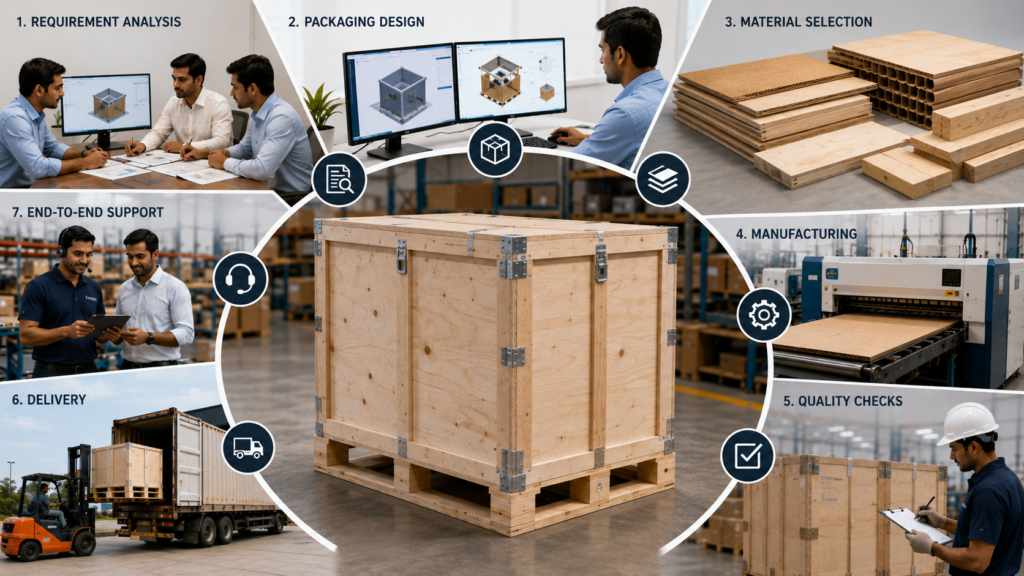
Turnkey packaging means a single partner manages requirement assessment, design, material selection, manufacturing, quality checks, and delivery. Instead of coordinating between several specialists, one team owns the full sequence, so design reflects real production and shipping conditions from the start rather than being corrected after the fact.
The Problem With Multiple Vendors
A fragmented model tends to create the same issues as it scales:
- Too many points of coordination. Every requirement means separate conversations with a designer, supplier, and manufacturer, each on their own timeline.
- Gaps between design and manufacturing. Misunderstandings about tolerances or materials often surface only after a batch is already produced.
- Inconsistent quality. Different vendors source similar materials from different suppliers, so two “identical” batches can behave differently in transit.
- Dispatch delays. A delay from any one vendor can hold up an entire shipment, with no single party accountable for the risk.
- Unclear accountability. If a shipment arrives damaged, figuring out whether it was the material, design, or handling takes longer than it should.
- Hidden administrative costs. Multiple purchase orders and specifications quietly consume procurement time.
- Slow change management. A redesign or new export market requires re-approval across several vendors instead of one quick adjustment.
This isn’t a rule that applies to every manufacturer. Some businesses manage multiple vendors well. The right structure depends on product complexity, order volume, and how much internal resourcing is available to manage it.
What Changes With a Turnkey Model
A single coordinated partner restructures how these stages connect:
- One point of contact instead of separate relationships for design, sourcing, and production
- Requirements understood once and applied consistently across batches
- Design and materials controlled by the same team, reducing rework
- Consistent quality checks across every run
- Packaging readiness planned alongside dispatch timelines, not independently of them
- Faster response to specification changes, since no cross-vendor sign-off is needed
- Easier standardization across product lines or facilities
In practice, this shifts the process from “product is ready, now find packaging” to one where packaging requirements are understood well before production output needs to move.
Industries We Support
Packaging needs differ by industry, which is part of why a coordinated approach outperforms assembling generic packaging from unrelated suppliers.
- Electronics and switchgear: protection against moisture, static discharge, and dust, evaluated together instead of under- or over-engineered by separate vendors.
- Automotive components: consistent specifications across component types and multi-stage supply routes.
- Aerospace components: high-value, dimensionally sensitive parts that need design, material, and compliance checks handled as one process.
- Solar equipment: packaging that protects against impact and moisture together, since panels and power systems travel long distances to installation sites.
- EV and battery products: combined weight, fragility, and handling sensitivity that standard packaging isn’t built for.
Sustainability Works Better as One Process
Sustainable packaging is easier to implement consistently when material selection, design, and logistics are evaluated together rather than as separate decisions. This includes reducing unnecessary material, choosing recycled or reusable options where suitable, and improving pack dimensions to cut wasted space. It’s worth noting that sustainable packaging doesn’t automatically cost less. The right choice depends on the specific product, material, and shipment pattern, which is why it works better as one coordinated evaluation.
When to Consider Turnkey Packaging
It’s worth evaluating if several of these apply to your operation:
- Packaging is sourced from more vendors than your team can easily track
- Dispatches are occasionally delayed because packaging isn’t ready
- Quality noticeably differs between batches or suppliers
- Products are frequently redesigned or customized
- You’re expanding into new export markets
- Transit damage or handling issues have been increasing
- No single vendor is accountable for the overall outcome
If only one or two apply, a well-managed multi-vendor setup may still be the more practical choice for now.
How We Approach End-to-End Packaging
We work with manufacturers across electronics, automotive, aerospace, and solar, managing packaging as a connected sequence rather than a set of separate purchases. Our process starts with understanding the product’s specifications, handling method, and shipping requirement, then moves through design, material planning, sample approval, in-house sourcing and production, quality testing, and delivery coordinated to match your dispatch schedule.
Sustainable materials, including recycled and compostable options, are considered as part of design and sourcing from the start. We also offer onsite and remote support for manufacturers who need execution closer to their own facilities.
The difference between buying packaging from several vendors and working with a partner that manages the full process comes down to where coordination, accountability, and consistency sit in your operation. As product variety, shipment risk, and export complexity grow, turnkey packaging brings design, sourcing, production, and quality control under one accountable process.
If managing packaging vendors is consuming time your production and logistics teams could spend elsewhere, we’re happy to assess whether a turnkey approach fits your products and shipping requirements.
FAQs
What is a turnkey packaging solution?
One partner manages the full packaging process, from requirement analysis and design through production, quality testing, and delivery, instead of a manufacturer coordinating separate vendors for each stage.
How is it different from just buying packaging materials?
Buying materials means purchasing boxes or crates while design and quality control may sit elsewhere. Turnkey packaging brings design, sourcing, production, and testing together under one team.
Can turnkey packaging support export shipments?
Yes. Packaging is typically designed and tested around the specific export route, transport mode, and product sensitivity, though regulatory requirements vary by destination and should be confirmed per shipment.
Does it reduce packaging costs?
It can reduce hidden costs tied to coordination, delays, and inconsistent quality, but actual pricing still depends on material, design complexity, and order volume.
What information is needed to get started?
Product dimensions, weight, fragility, handling method, storage conditions, and shipping route, so design and material planning reflect the product’s actual requirements.